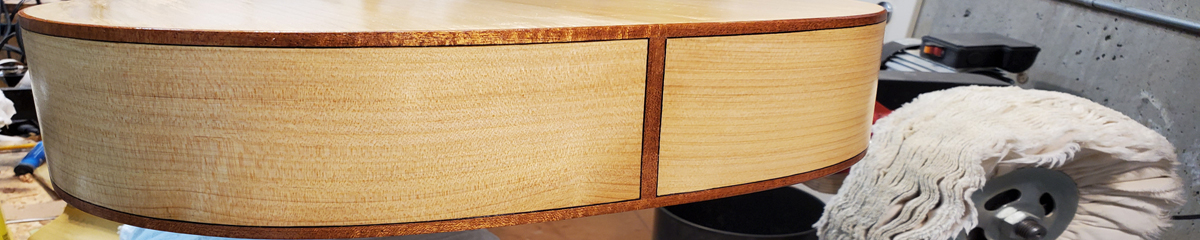
Ok I have a couple questions. If anyone can help me I would be most graceful.
I am using Aqua Coat for my pore finish on a kit guitar. I will do it 3 times and let dry for 24 hrs. and then sand with 320 grit. I have already did it 2 times tomorrow will be # 3. If I think it needs more I will do another coat.
I am doing a Mahogany guitar with Adi. top. I know that I do not use the AC on the Adi.
Once the pore coats are finished and it is time for the Tru-Oil Do I put a coat of Shellac on the entire guitar first and give it a couple days to harden or forget the Shellac and start the Tru-Oil??
Another question once I start the Tru-Oil do I do anything in between each coat??
Tru_Oil Question
Moderator: Dave Bagwill
Forum rules
The purpose of this forum site is to provide a means for acoustic guitar makers at all skill levels to forward information, share experience and ask questions if project obstacles are encountered. We ask that egos be left at the door – the highest levels of courtesy and respect are to be shown to all. Posts containing disparaging comments will be removed. The “Acoustic Guitar Construction Forum” is owned by Kenneth Michael Guitars and is copy protected. Direct links to luthier suppliers are not permitted and will be edited.
The purpose of this forum site is to provide a means for acoustic guitar makers at all skill levels to forward information, share experience and ask questions if project obstacles are encountered. We ask that egos be left at the door – the highest levels of courtesy and respect are to be shown to all. Posts containing disparaging comments will be removed. The “Acoustic Guitar Construction Forum” is owned by Kenneth Michael Guitars and is copy protected. Direct links to luthier suppliers are not permitted and will be edited.
-
Dave Bagwill
- Posts: 5993
- Joined: Tue Dec 13, 2011 7:44 pm
Re: Tru_Oil Question
This guy - Dan Pettingill - is a real pro and here is his method. You've already pore-filled so you can skip that first part.
I use a lot of True Oil on my lap steels and one thing I've found is that TO is a very forgiving finish and everyone finds a way that works best for them.
My method has been a moving target and evolves a little each time. My way is certainly not the only way, its just a way that works for me.
For grain fill, I do the slurry wet sanding with True Oil much like Bruce described, though I use a big pink eraser as a block and sand with the grain.
Once I get the grain filled, I use a combination of wiping it on with a piece of lint free cotton, (large pre-cut gun cleaning patches), and then either spray the last couple final coats with a small gravity feed detail gun or do the thinned "glaze coat" as Ron described.
Given normal temps and conditions, you can recoat TO in a couple hours. The 'trick' is to not slop it on, full and even light coats works best.
For building body, I'll generally do 3 light coats a day wiped on with the direction of the grain. No need to over work it, I just lay it down with full long strokes and then give it a couple hours before the next light coat. Again, the key here is light coats, avoid the temptation to lay it on thick.
The next morning before any more coats, I take a small flat hard block and lightly wet sand with 1000 grit and a little spritz of mineral spirits for a lube.
For me, 1000 grit seems to be a good balance of grit at this stage as cuts fast enough to work without being overly aggressive on the new finish. Once I get a good level film built, I move up to 1500 for a day, then 2000 for a day. After the 2000, I do one light / full / quick "glaze coat" or
spray the last coat and let cure a week.
For maximum gloss, I reduce the Truoil 50% with naphtha for the final coat. This reduces streaking from the rag too.
This works well, though I use mineral spirits instead, up to 50% mineral spirits is the recommended thinner / max ratio as per Birchwood Casey.
A couple misc notes, Birchwood Casey does have True Oil in a spray can. Not a lot of places carry it, but its available direct from BC's web site. For best results with their spray can, warming the can in warm tap water helps.
On big flat surfaces, I prefer wet sanding with a block over steel wool if I'm going for that mirror finish.
If you let Tru Oil cure and harden for a while, it gets progressively harder. I waited about a month on a guitar tailpiece that I finished with Tru Oil. Then I worked through all the grits in my
Micro mesh pad set. I rubbed with dry pads. I got a watery, glass-clear result. Fabulous. But you've GOT to let it harden up before you do that.
-Under permanent construction
Re: Tru_Oil Question
Dave thanks for all the Great information, but my questions have not been answered . What about the Shellac? I am thinking something needs to be put on the top Adi. spruce before I start the Tru-Oil and sanded.
I am happy with my pore fill on the sides and back, but the top has me worried. I just don't know what to do there.
A couple people told me to use the Shellac, but I really don't know.
I am happy with my pore fill on the sides and back, but the top has me worried. I just don't know what to do there.
A couple people told me to use the Shellac, but I really don't know.
-
Dave Bagwill
- Posts: 5993
- Joined: Tue Dec 13, 2011 7:44 pm
Re: Tru_Oil Question
Actually, the TO acts as a sealer, so the shellac is absolutely not necessary. It won't hurt a thing - I've checked with Birchwood-Casey people and asked the very same thing - the only point of shellacking would be to color the wood a bit.
Straight TO as in the quoted entry above will do the job nicely. I've done it on a dozen guitars.
I have used seal-coat to shade a top or two before the TO; and I've used a thinned coat of amber shellac for the same reason, but it must be de-waxed.
You can save yourself some time and just go straight TO.
Keep us posted! If you have any pix to share, we'd love to see them.
-Under permanent construction
Re: Tru_Oil Question
Thanks Dave will do. I was thinking that I would like to shade the top a bit, but have not made up my mind yet. Nice to know that the shellac will do that.
I have taken the top to 320 grit so you say I could just go ahead with the TO right. The back and sides have had all the pore coats needed (3) I need to sand off the last coat and then I also use air to clean it with.
Thanks again.
I have taken the top to 320 grit so you say I could just go ahead with the TO right. The back and sides have had all the pore coats needed (3) I need to sand off the last coat and then I also use air to clean it with.
Thanks again.
Re: Tru_Oil Question
Dave what do you think is the best to use if I want to shade the top??
Looking at a top that is shaded and one that is not which one do you like the best??
Looking at a top that is shaded and one that is not which one do you like the best??
-
Dave Bagwill
- Posts: 5993
- Joined: Tue Dec 13, 2011 7:44 pm
Re: Tru_Oil Question
If there is a 'theme' to the guitar - bindings, bridge, fretboard, something that ties the guitar together as a whole, shading is not a concern to me. A very white Englemann top, set off by darker bindings and purflings looks really cool. There are 'aging' toners available that will give a spruce top that aged look, but I haven't messed with them.
As long as there is a theme, it's just a matter of taste whether the top is 'toned' or not.
As long as there is a theme, it's just a matter of taste whether the top is 'toned' or not.
-Under permanent construction